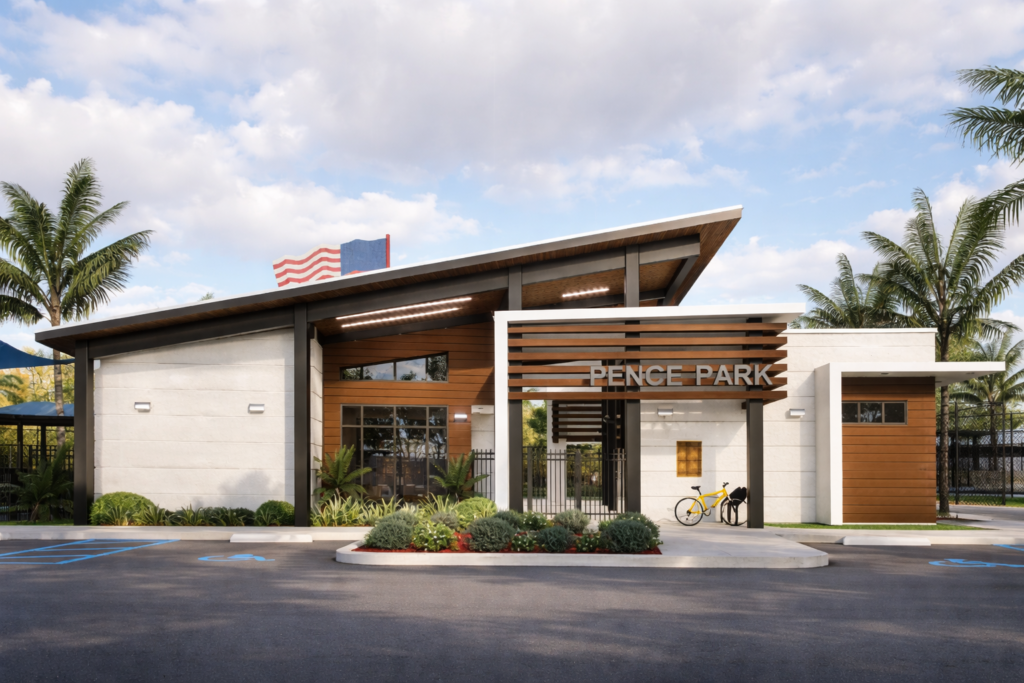
Located within a residential neighborhood in Boynton Beach, Florida, Pence Park currently serves as a small community recreational space featuring:
While the park already functions as an important neighborhood amenity, the design process began by identifying opportunities to improve how the site could better serve the surrounding community both socially and functionally.
During the early design process, a major focus was understanding how the park relates not only to the site itself, but also to the surrounding neighborhood fabric and future growth of Boynton Beach. While the existing park provides valuable recreational space, much of the site felt disconnected, underutilized, and limited in flexibility for larger community use.
The contextual analysis revealed the park’s close relationship to several important and community anchors including:
Because of these surrounding destinations and future growth patterns, the project team approached Pence Park as part of a larger civic network rather than an isolated neighborhood park. The site became an opportunity to help strengthen connectivity between nearby residential areas, public institutions, and recreational spaces.
The design team then focused on how users would arrive at and move throughout the site:
Recreational spaces were also strategically organized based on environmental and operational considerations:


Once the broader site relationships and circulation patterns were established, the team then shifted their focus on organizing the park’s programming in a way that creates clear connections between recreation, gathering, and community-oriented spaces.
The overall site layout was intentionally designed around a central activity spine that branches outward into the park’s primary program elements. This organizational approach allows users to intuitively move throughout the site while maintaining strong visual connections between spaces.
The main building and covered plaza were positioned at the center of the park to function as the primary social and operational hub for the site. This placement allows the building to maintain direct visibility toward the surrounding recreational amenities while reinforcing its role as the heart of community activity within the park.
Programmatically, the park was designed to support a variety of user experiences including:
Interior spaces include:
The multi-purpose room was envisioned as a flexible civic space capable of accommodating community meetings, recreational programs, educational activities, and neighborhood events. Large openings, natural light, and visual transparency help strengthen the connection between indoor and outdoor activity throughout the park.
The recreational amenities were then arranged around the building to reinforce visibility and connectivity across the site:
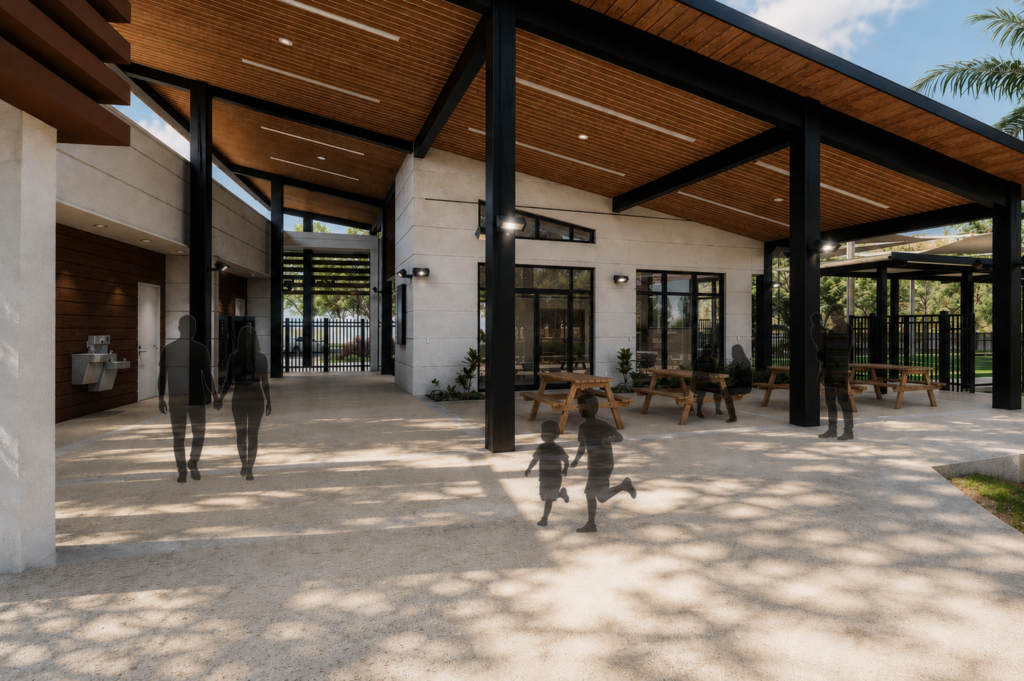
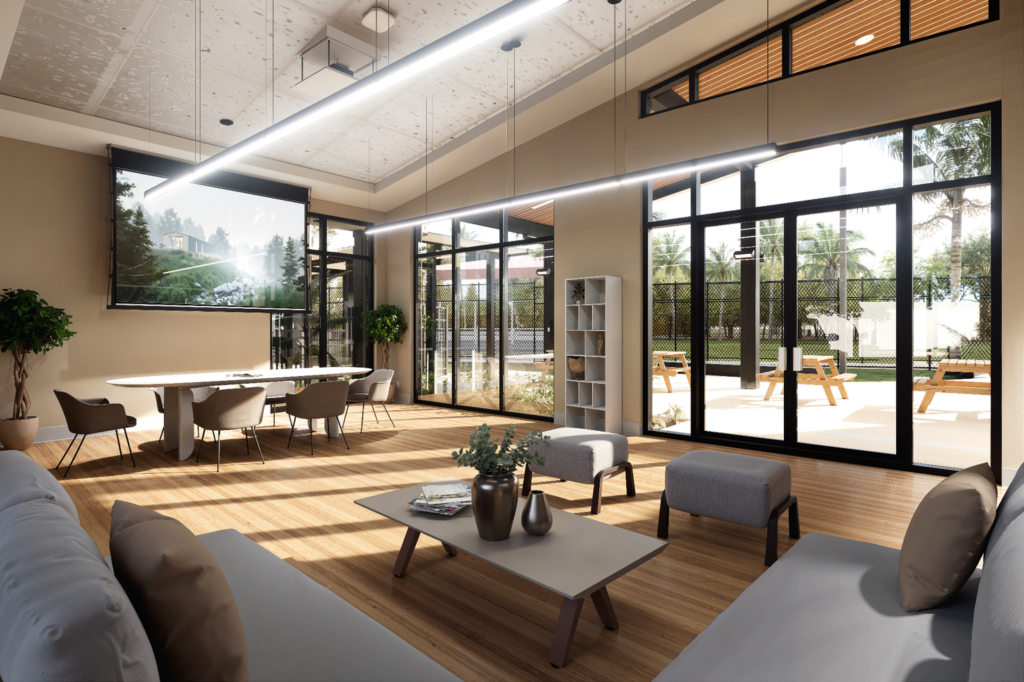
The project incorporates principles of Crime Prevention Through Environmental Design (CPTED) to strengthen both real and perceived safety within the site. Rather than relying solely on physical barriers, the design uses visibility, circulation, and strategic organization to naturally encourage activity and passive surveillance throughout the park. One of the primary CPTED strategies involved maintaining direct sightlines across major program areas:
Landscape design also played a major role in reinforcing visibility and safety:
Additional CPTED elements integrated into the design include:

One of the key architectural design features is the roof form of the main building, which was intentionally shaped to respond to South Florida’s climate conditions. The extended roof overhangs help create shaded outdoor environments while supporting passive airflow and ventilation throughout gathering spaces and circulation areas.
The covered plaza and building overhangs were designed not only as aesthetic elements, but as functional climate-responsive features that encourage year-round usability by reducing direct sun exposure and creating cooler outdoor gathering areas.
Another major design consideration involved rethinking traditionally utilitarian site elements as opportunities for placemaking and community identity. Rather than treating the maintenance building and dumpster enclosure as visual afterthoughts, the design integrates large-scale public artwork directly onto these structures to transform them into active architectural features within the park.


This design strategy allows infrastructure elements that are often considered visual eyesores to instead contribute positively to the user experience through:
Incorporating artwork into the architecture itself, the project creates moments of character and identity throughout the park while reinforcing the idea that every component of the site can contribute to the overall public experience.
These creative design decisions help elevate Pence Park beyond a standard recreational facility and support the project’s broader vision of creating a community-centered public destination.