
Wildlife Data Analysis & Ecological Studies

We support agencies and NGOs in evaluating listed species and translating analytical results into practical species and habitat management plans that meet NEPA and ESA decision-making and documentation requirements.

DATA ANALYSIS

Analytical Support (existing data → defensible decisions)

Dr. Fernandes applies rigorous population and geospatial analyses to convert existing wildlife monitoring datasets into defensible, decision‑ready management outcomes. His work emphasizes transparent uncertainty, reproducible methods, and documentation suitable for regulatory or planning contexts. Using advanced population modeling, he estimates key demographic parameters (e.g., survival, recruitment, and abundance) and quantifies how habitat conditions and management actions influence population dynamics across taxa.

Typical support includes

  • Scoping Consult: Defining management goals, regulatory drivers, and analysis needs.
  • Feasibility Review: Evaluating existing datasets relative to study questions, assumptions, and constraints.
  • Data QA/QC & Preparation: Validating, documenting, and delivering analysis‑ready datasets.
  • Analysis: Applying statistically and scientifically robust analytical methods with explicit treatment of uncertainty.
  • Decision-Ready Documentation: Delivering technical reports suitable for management use.
  • Optional Briefing: Presentation of results and implications for management to project teams.

ECOLOGICAL STUDIES

Study Design & Implementation (new data + analysis → management-ready guidance)

When additional information is needed, we integrate wildlife demography and agency experience with trusted field partners to design and implement field studies (e.g., mark–recapture, nest survival, occupancy). Our sampling designs balance statistical power, management relevance, and real-world budget and logistics constraints to produce monitoring data that directly supports decisions and environmental documentation.

Typical support includes

  • Purpose/Need & Objectives: Define study objectives, management needs, and regulatory drivers.
  • Study Questions & Feasibility: Defensible questions within budgets, schedules, and field constraints.
  • Best Available Science Review: Synthesize literature, agency guidance, and existing data to inform study design.
  • Methods & Data Frameworks: Select sampling designs and data structures to produce analysis‑ready data.
  • Field Studies & Data Analyses: Conduct/ oversee field work and analyses for defensible impact assessment, monitoring, or trend evaluation.
  • NEPA‑Ready Documentation: Reports with interpreted results, documented uncertainty, and supporting materials.

FOREST MANAGEMENT & KIRTLAND'S WARBLER POPULATION PERFORMANCE

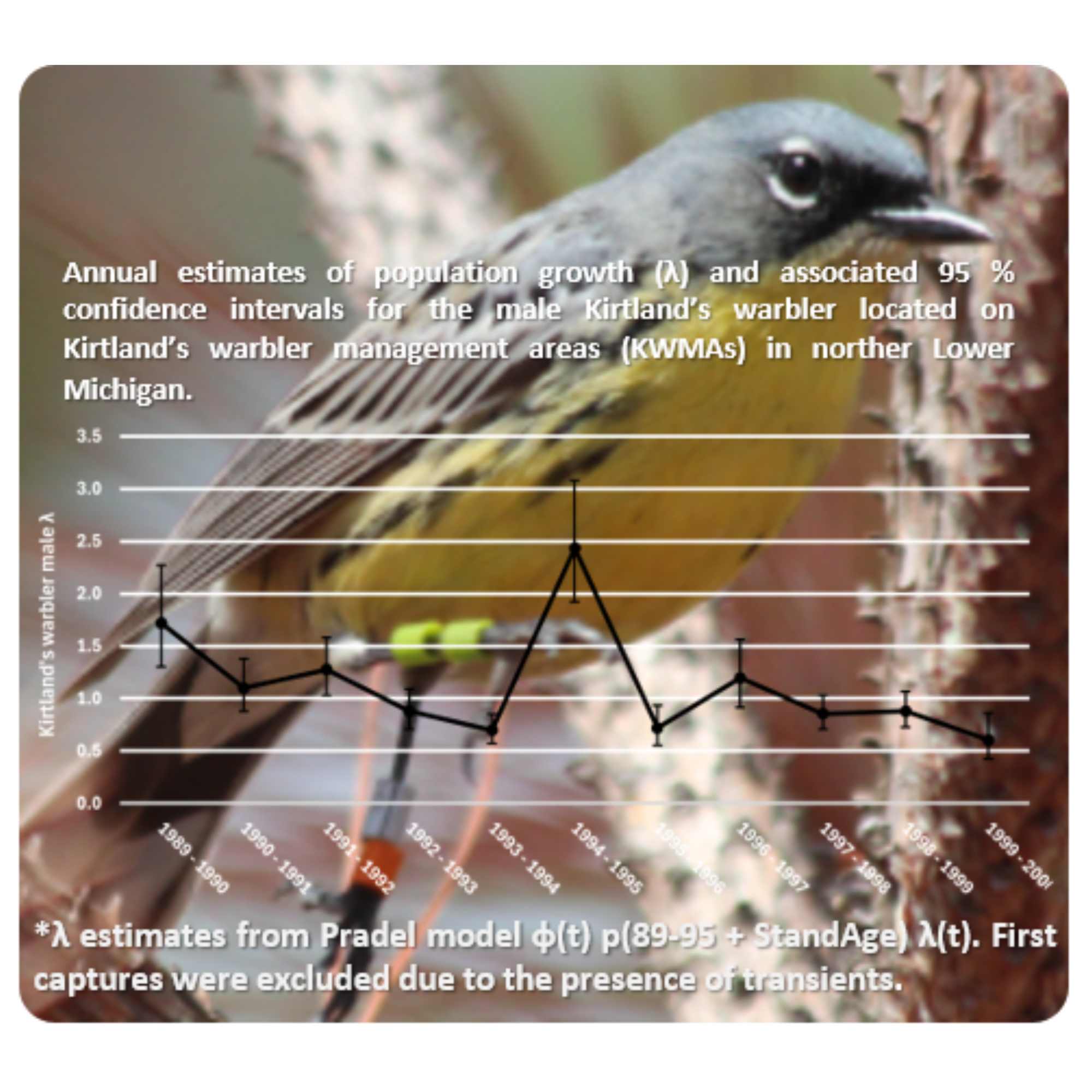
  • Investigated the influence of forest management treatment type on Kirtland’s warbler (Setophaga kirtlandii) demographic response for U.S. Forest Service, Northern Research Station, Rhinelander, WI.
  • Greatly increased the value of existing monitoring data by integrating multiple banding survey datasets into a single analysis-ready capture-history database with consistent coding and metadata.
  • Implemented custom QA/QC data validation scripts to identify and correct capture-history database inconsistencies and errors, maximizing data retention while improving inferential reliability.
  • Estimated demographic parameters and population trajectories using CMR modeling (e.g., CJS, POPAN, Pradel), producing inferences φ (apparent survival/return rate), p (detection), λ (population growth), and N (abundance) to support management.
 

GEOSPATIAL ANALYSIS OF CANADA LYNX SEASONAL HABITAT USE

  • Integrated GPS and VHF long-term telemetry datasets into a single, QA/QC validated dataset with consistent coding and metadata.
  • Prepared analysis-ready dataset compatible with analytical methods’ assumptions.
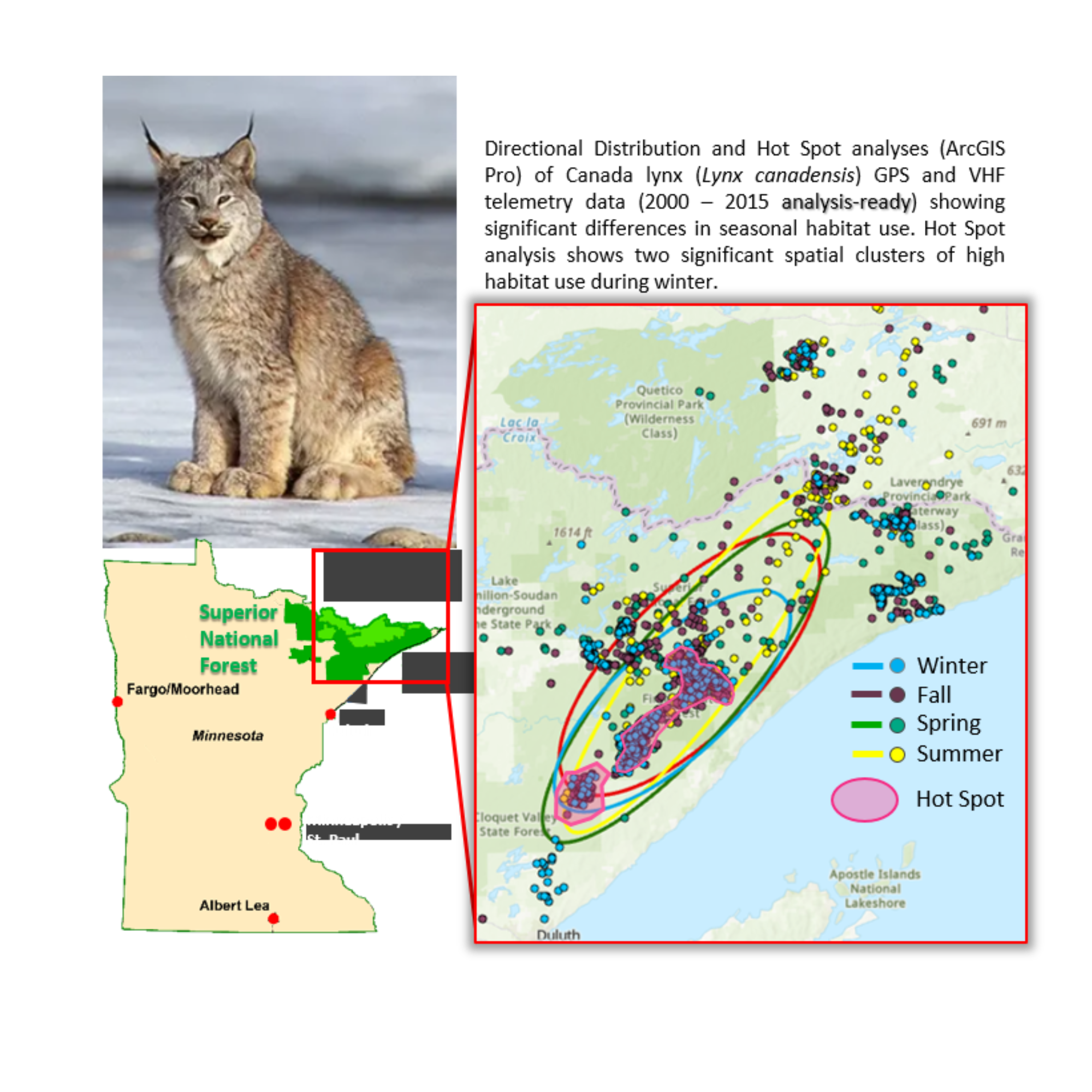
  • Used ArcGIS Pro Spatial Analyst, Spatial Statistics tools to quantitatively describe seasonal differences in directional and distribution trends in lynx habitat use.
  • Analysis identified two significant spatial clusters of habitat use (Hot Spot Analysis, ArcGIS Pro) within the National Forest - critical to lynx winter survival and the long-term persistence of the species in this area.
 

EVERGLADES SMALL MAMMAL LONG-TERM MONITORING

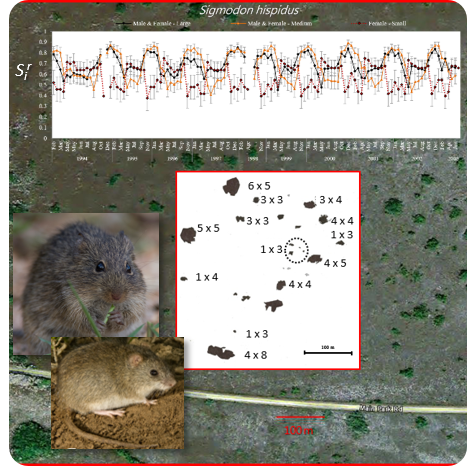
  • Conducted Everglades’ small mammals study investigating the influence of tree island size and seasonal hydroperiods variables on rodent species’ long-term population dynamics for the USGS and National Park Service.
  • Small mammal live-trapping and ear tagging.
  • Maximized value of 11 years of monitoring data by integrating multiple survey datasets into a single, QA/QC validated, analysis-ready dataset with consistent coding and metadata.
  • Facilitated demographic analysis using custom scripts to define new and insightful database variables based conditional relationships among individuals’ capture history entries.
  • Created climate database and quantitatively described climate extremes.
  • Applied advanced population modeling (CJS, Popan, Pradel, Multistate) to quantitatively describe the influence of hydrology, climate, and landscape variables on rodent survival and transition rates among Everglades’ tree islands.


Project Gallery